The Trail Under the Power Lines
A dirt fire road under transmission towers at Rancho San Antonio Preserve became the thing that made Sunnyvale feel like home after moving from Texas.
The Trail Under the Power Lines
We moved here from Dallas, and the first thing California took away from me was the sound of the air conditioner.
In Texas, that low mechanical hum was the background track of life from April to October. You didn't open windows; you defended against the outside. Here in Sunnyvale, I keep waiting for the heat to arrive and it simply doesn't. Mornings come in cool and blue. Afternoons warm up just enough to make you want to be outdoors. By evening there's a breeze that comes up off the bay and slides through the window screens, and the house cools itself while we sleep. Months in, and I still catch myself standing at an open window at nine at night, slightly suspicious, like the weather is a free trial that's about to end.
That climate is what pushed us outside. And going outside is how we found the PG&E Trail.
A trail named after a utility company
I want to be honest about my first reaction: the name did not inspire me. PG&E Trail. It sounds like a service road, which is exactly what it is — a wide dirt-and-gravel fire road that climbs into the hills at Rancho San Antonio Preserve, following a line of high-voltage transmission towers up the ridge. I went the first time with low expectations. A walk is a walk, I figured.
Then the trail turned a corner about twenty minutes in, the trees opened up, and the entire Santa Clara Valley was just there — laid out flat and hazy all the way to the Diablo Range on the far side, the bay glinting somewhere off to the left, the whole of Silicon Valley reduced to a soft gray-green grid you could cover with your thumb.
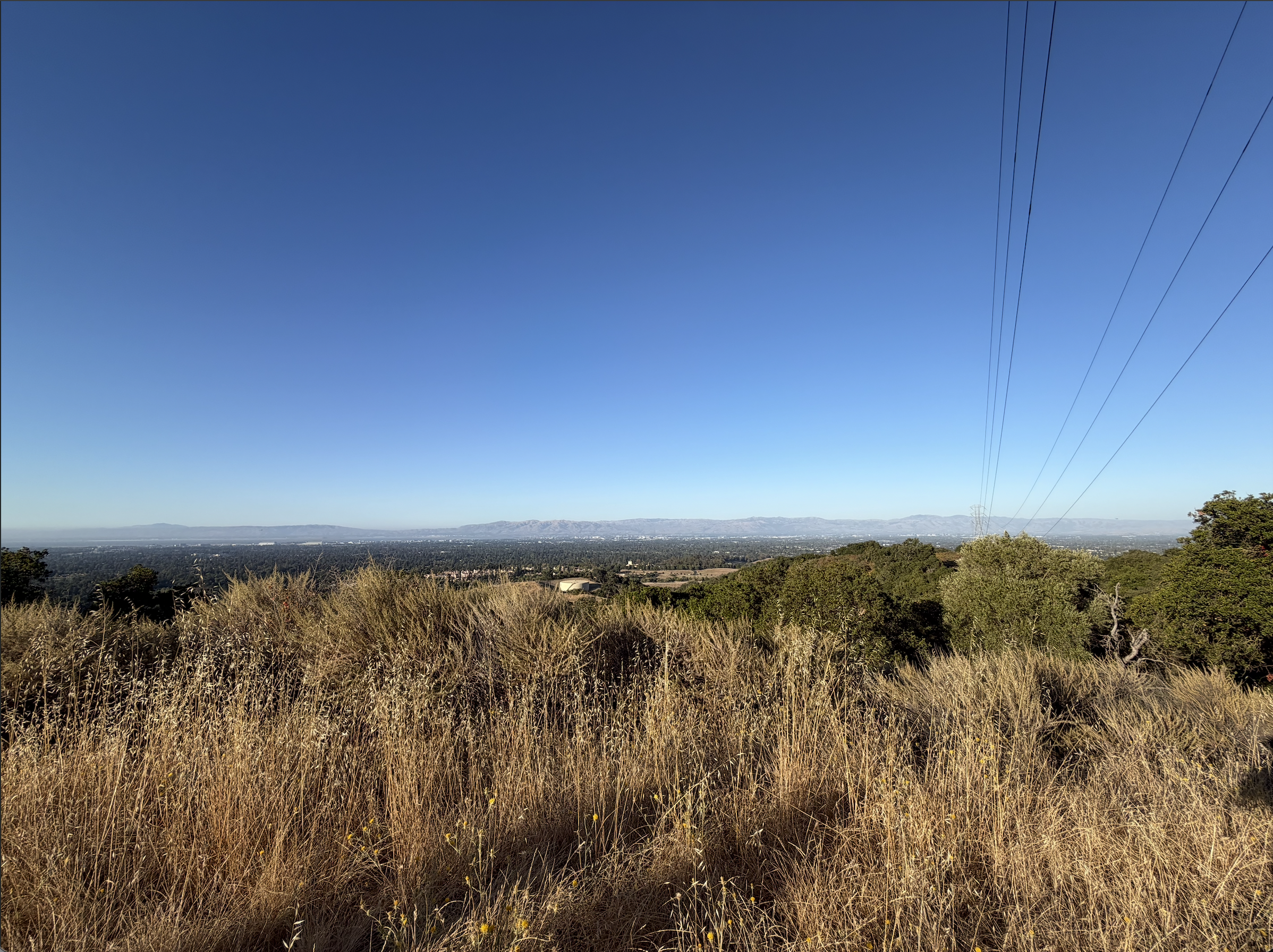
And yes, the power lines are in the shot. They're in almost every shot. I've stopped trying to crop them out. There's something honest about them — this is a working landscape on the edge of a working valley, and the towers are the thread you follow up the hill. You hear them buzzing faintly on warm afternoons. They stitch the wild part and the built part together instead of pretending one doesn't exist.
Something for whoever you are that day
The thing that turned us from visitors into regulars is that the trail doesn't demand a single kind of effort.
If you want to be humbled, the PG&E Trail will oblige. It runs roughly three and a half miles one way, climbing something like 1,200 feet, and the grade is relentless in that patient fire-road way — never technical, never a scramble, just up, again, still up. It's wide and smooth and completely unforgiving. It ends around 1,600 feet where it meets the Upper High Meadow Trail, and the people who run it as an out-and-back are logging eight-plus miles before most of the valley has had coffee.
If you want something gentler, you stitch together a loop and go home. Coming up the shaded singletrack of the Coyote Trail and dropping back down through Wildcat makes a pleasant four-mile morning with about 700 feet of climb — a couple of hours, a real workout, no suffering required. On the days when we just want air and a conversation, we walk out to the meadow and the farm and turn around, and that counts too.
That range is the whole trick. My husband and I have very different definitions of "a nice walk," and this is one of the few places where we don't have to negotiate.
Every turn is a different room
What I didn't expect was the variety packed into so little distance. You start out under a canopy of oaks and bay laurels, cool and dim, with a creek muttering somewhere below you. Then you break out onto an exposed south-facing slope where the grass has gone completely gold and the chaparral smells like hot dust and something herbal. Then you duck back into shade. Then it opens again, and the valley's a little smaller and a little farther away than the last time you looked.
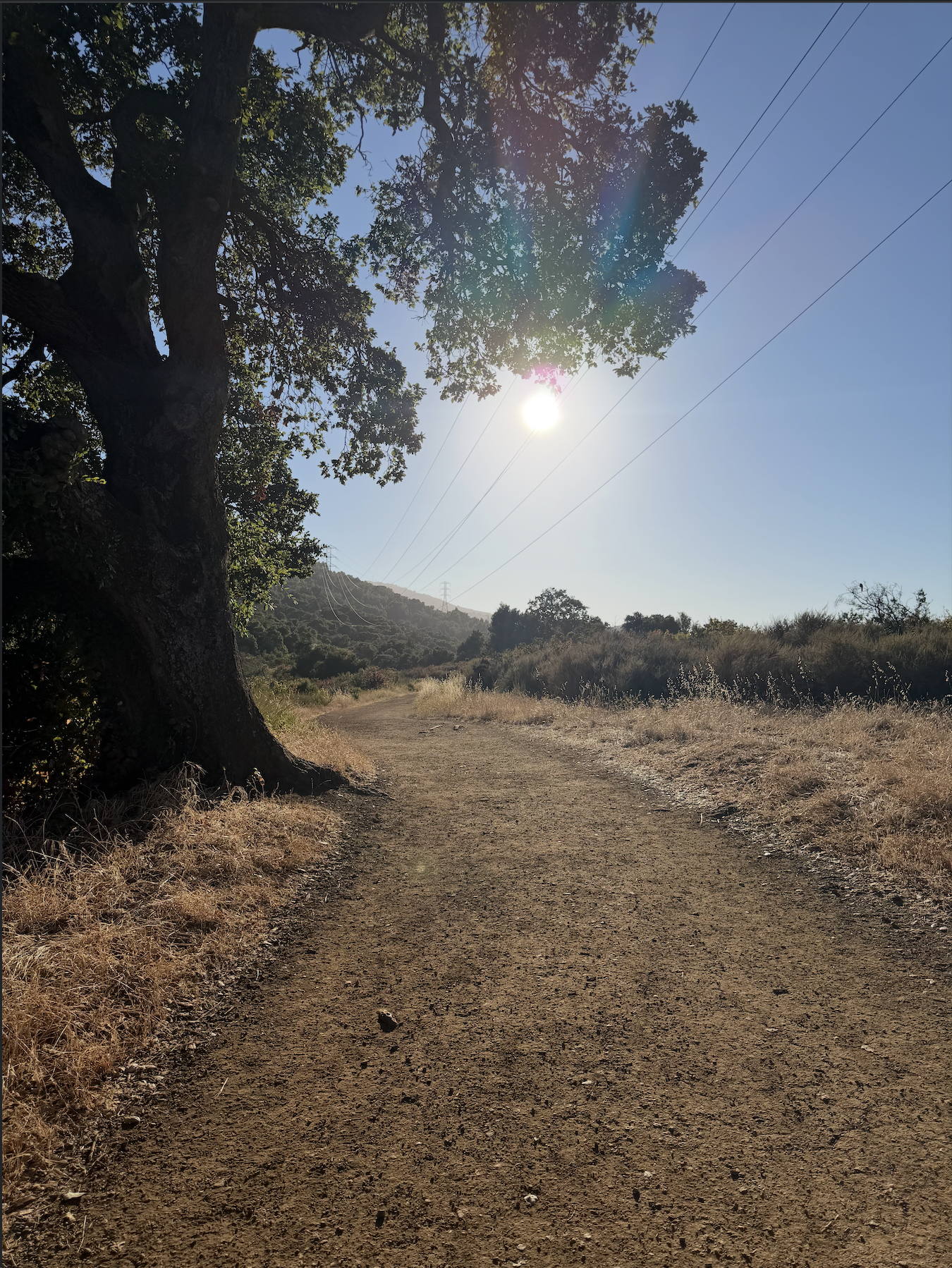
There's a bench up there under an oak. It faces roughly into the morning sun, and if you get there early enough on a weekday, there is nobody. Not "not many people" — nobody. Just the grass ticking in the wind, a scrub jay complaining about something, and the light coming through sideways at that low angle that makes even dry weeds look expensive.
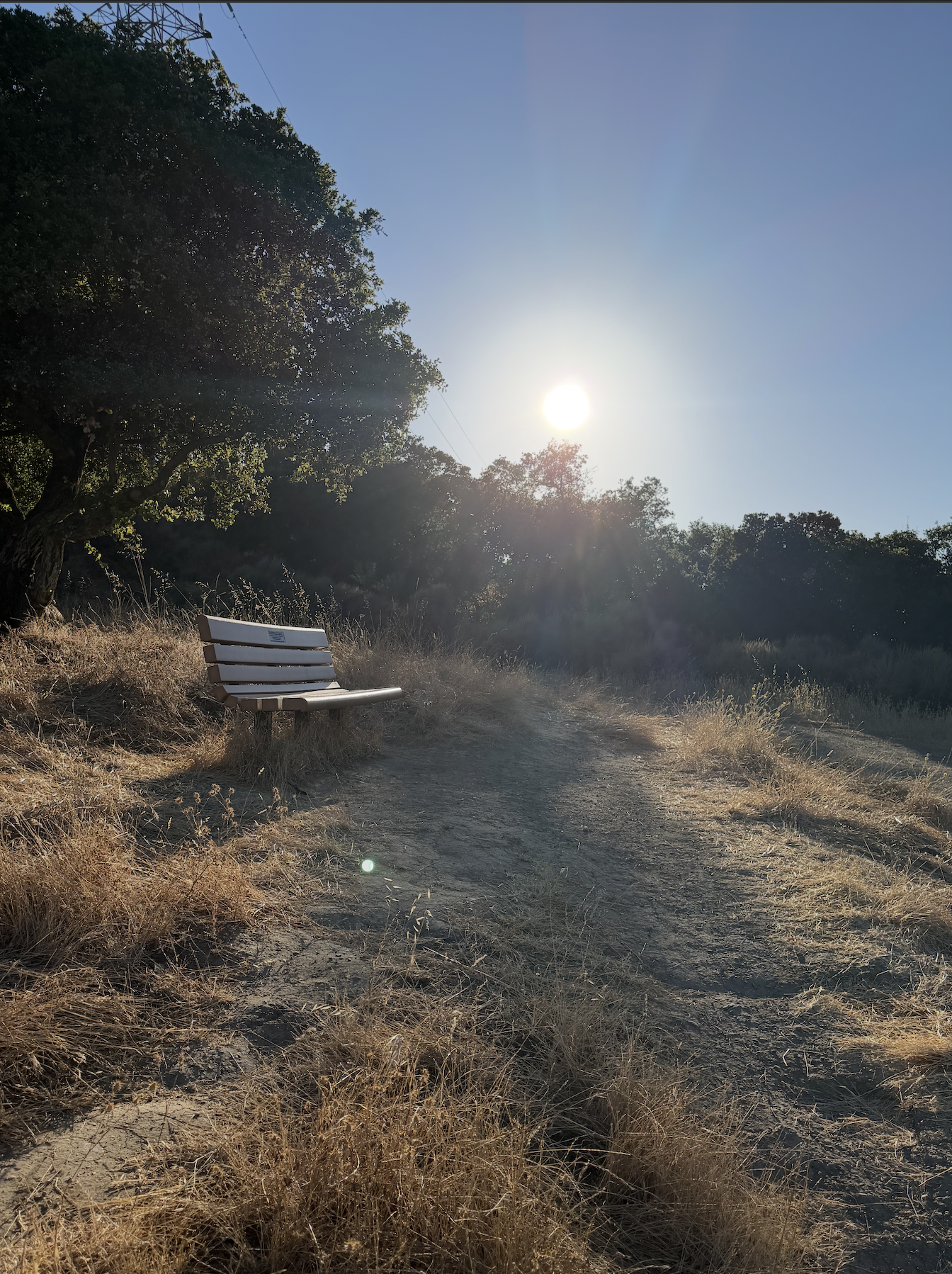
I've sat on that bench and done absolutely nothing for fifteen minutes at a stretch. In a valley this dense with ambition, being handed that kind of quiet, ten minutes from a freeway, free of charge, feels faintly like getting away with something.
What we've learned (the practical part)
If you're going, a few things worth knowing:
- Parking is the real difficulty rating. The lots fill early on weekends and holidays. Aim to arrive before 7:30 a.m., or come on a weekday. Midpen posts live parking availability online and on a signboard at the entrance, which has saved us more than one wasted drive.
- The gate opens at 8 a.m., and the park stays open until half an hour after sunset. Plan the descent — those shaded singletrack sections go dark well before the official sunset time.
- No dogs. None. This one catches a lot of people off guard. Service animals are accommodated; pets are not. Fremont Older Preserve, just down the road, is the dog-friendly alternative.
- Bring more water than you think. The upper half of the climb is exposed, and California dry heat is sneaky in a way Texas humidity never was — you don't feel yourself sweating, so you don't feel yourself losing it.
- Say hello to the goats. Deer Hollow Farm sits on the way in — a genuine working farm with chickens, pigs, and goats, free to walk through. It has become our unofficial turnaround point on lazy days.
- Look up and look around. Deer are near-guaranteed. Wild turkeys travel in absurd numbers. Hawks work the thermals over the meadow. Bobcats and mountain lions live here too, though you'd be lucky (or unlucky) to see one.
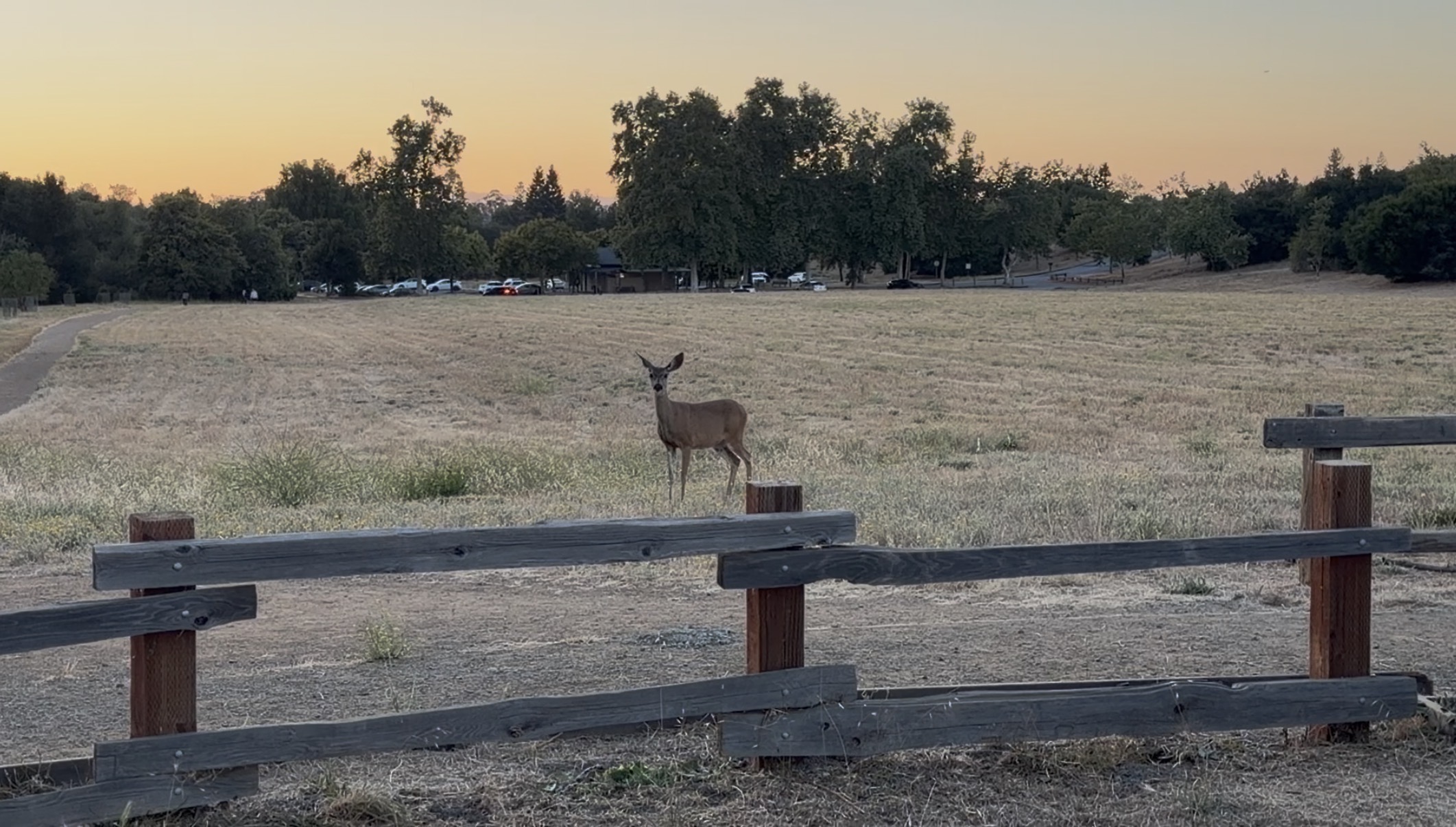
A deer pausing mid-graze in the dry grass along the trail
Why we keep coming back
I thought moving across the country would be defined by big things — a new job, a new house, learning which grocery store is the good one. Instead, the thing that's made this place feel like ours is a dirt fire road with power lines over it, twenty minutes from the front door.
We've done it in the flat gray of early morning and in the gold hour before the gate closes. We've done the long version and the lazy version. It's never quite the same walk twice, which is, I think, the actual reason we're hooked. The trail keeps offering slightly different versions of itself, and we keep showing up to see which one we get.
Some places are super quiet, and having that moment to yourself is priceless.
Come early. Bring water. Leave the dog at home. Take the bench when you find it empty.